BIOSATMYA · THE SATMYA SERIES
What Is Bio-Individuality? Meet Its Ancient Ayurvedic Parallel: Satmya
“Bio-individuality” is everywhere in wellness right now. Here’s what the term actually means, the evidence behind it, and a strikingly similar idea in classical Ayurvedic texts — Satmya.
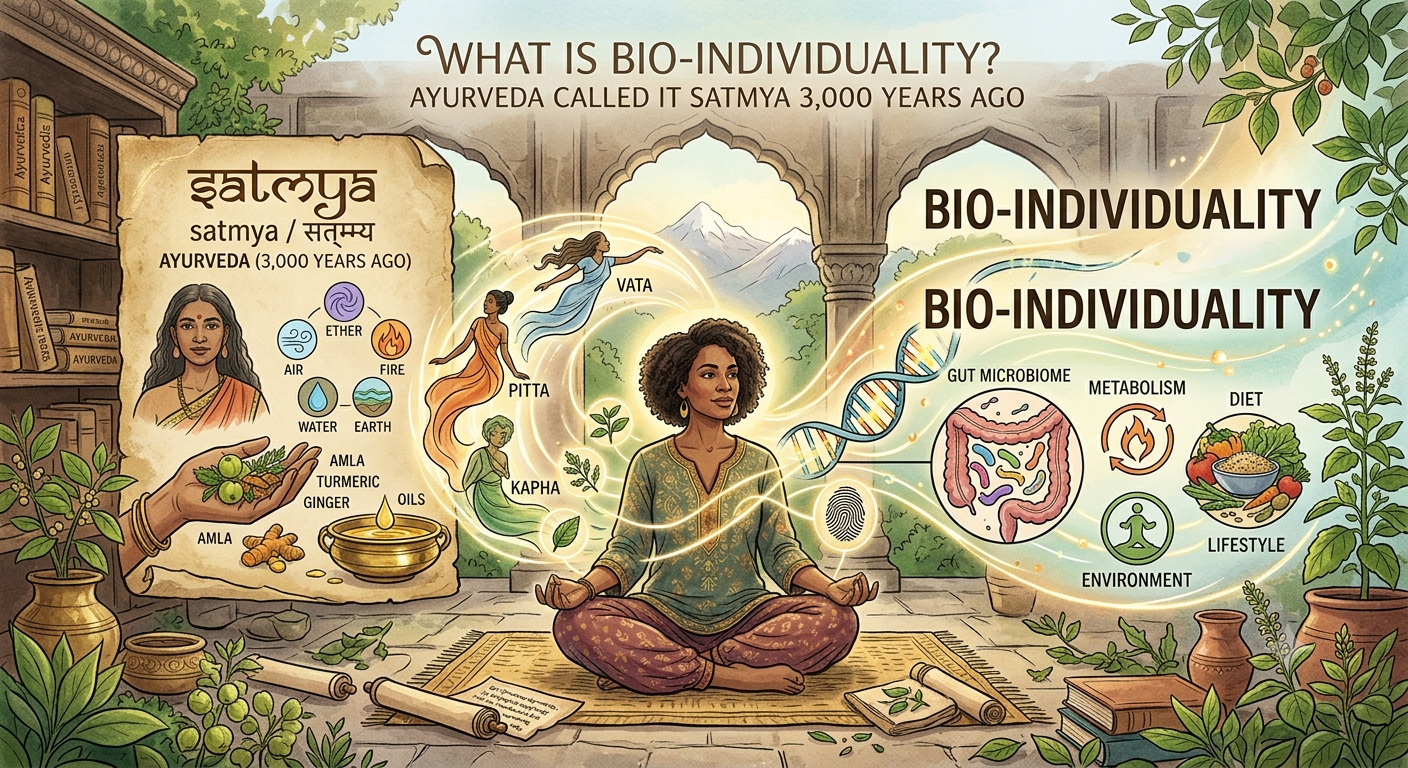
If you’ve searched “what is bio-individuality” recently, you’re part of a fast-growing crowd. The term has moved from niche nutrition circles into mainstream wellness conversation almost overnight — podcasts, social feeds, and coaching programmes are all using it to describe the same basic idea: that health advice built for “everyone” often fits no one particularly well.
It’s a genuinely useful term. It’s also, as it turns out, describing something considerably older than its current popularity would suggest.
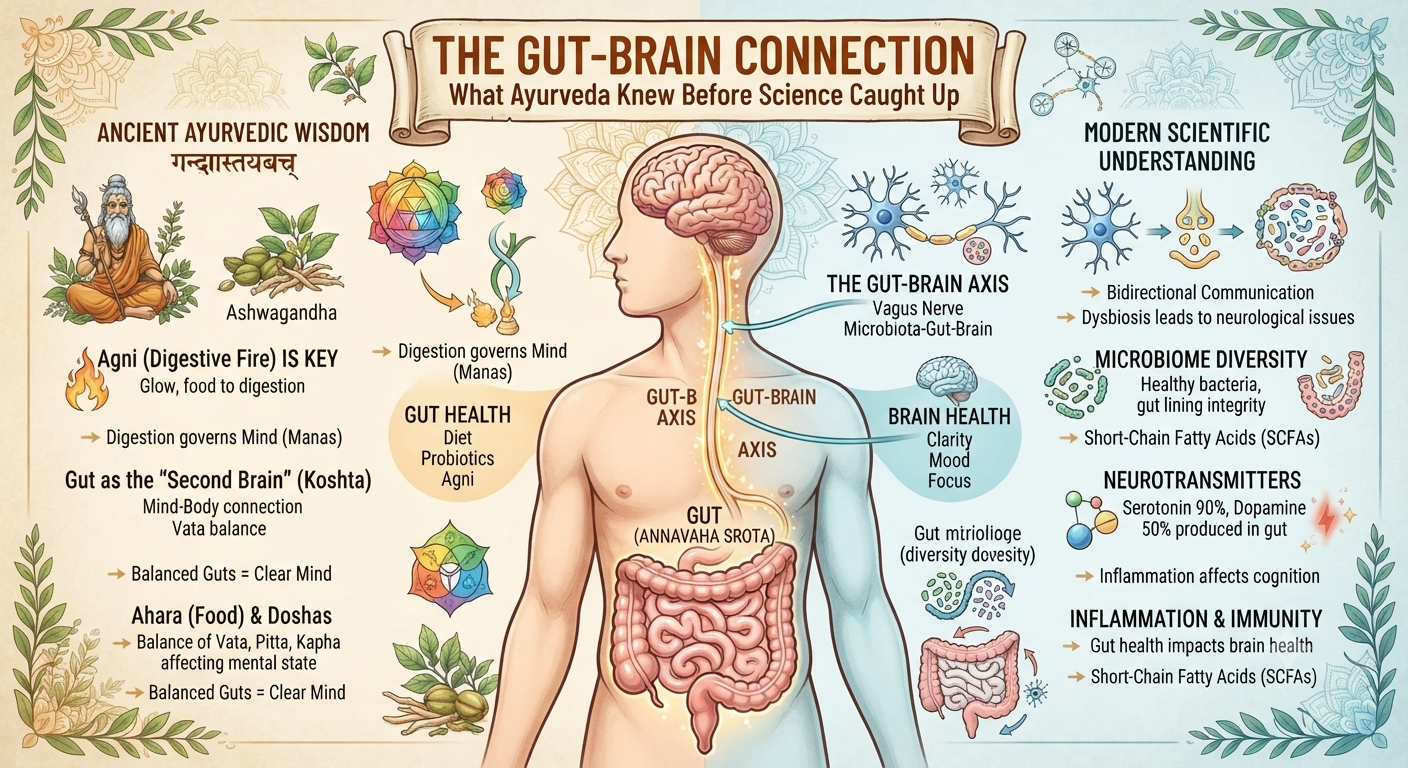
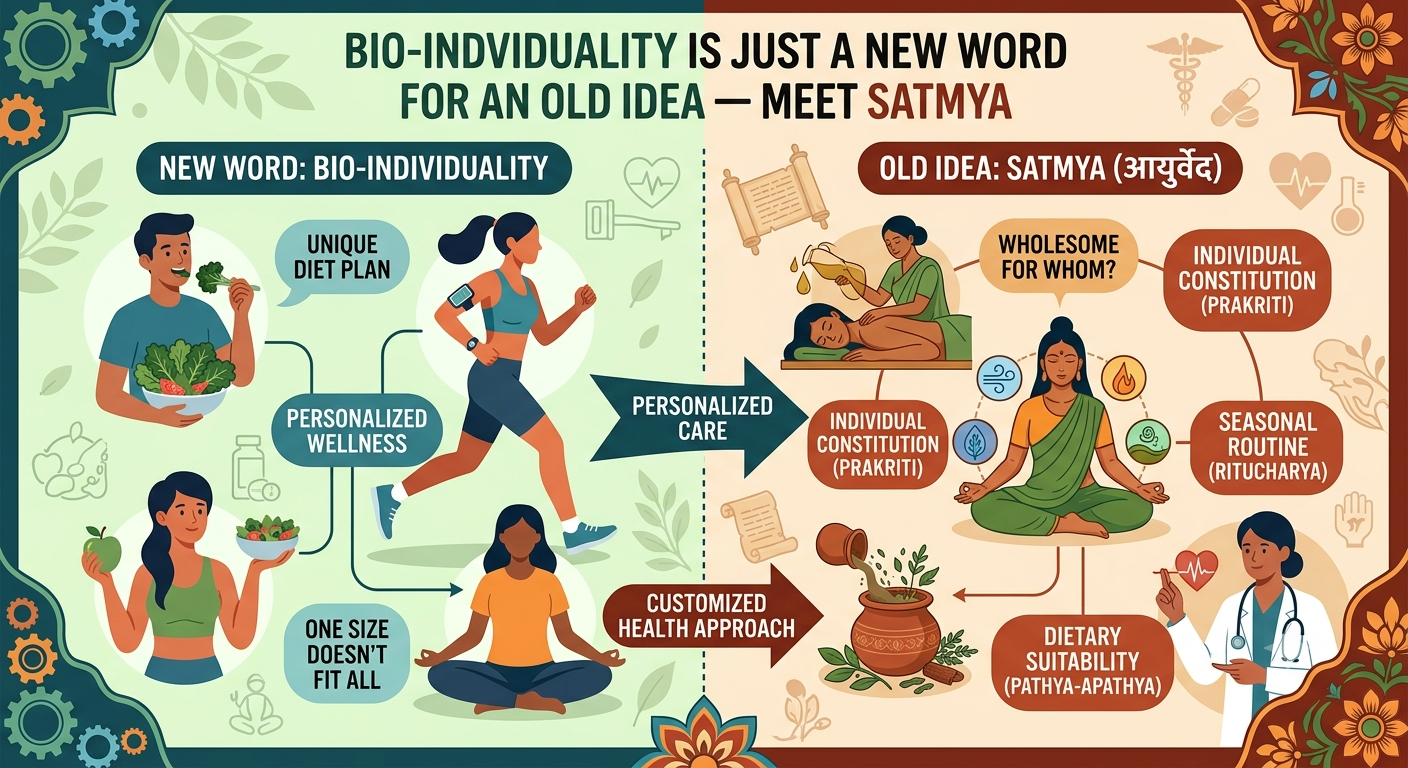
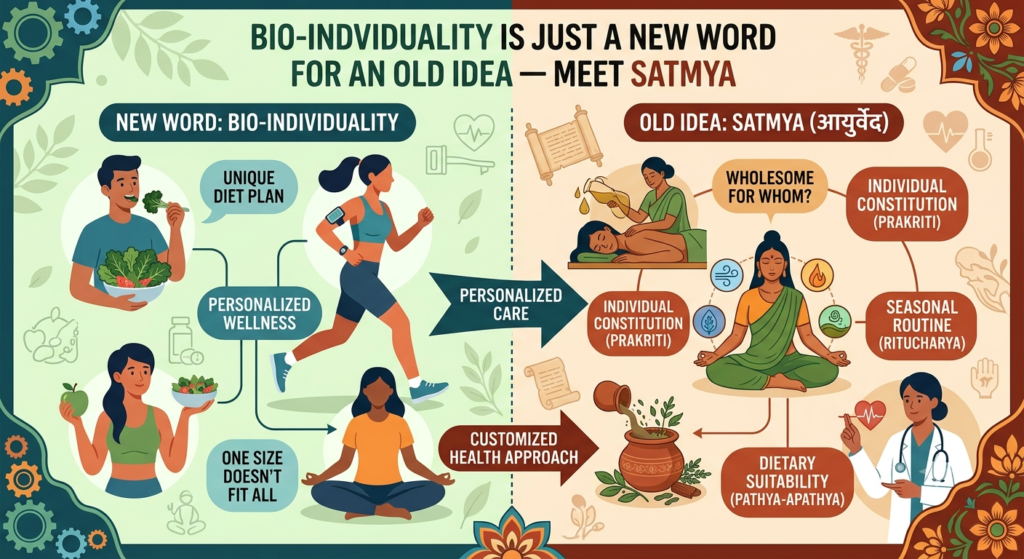
In current usage, bio-individuality refers to the idea that every person’s biology — genetics, gut microbiome, stress load, digestion, environment — is different enough that a single “correct” diet or health protocol cannot exist. What works for one person’s body may do very little, or even cause harm, for someone else’s.
It’s a reasonable claim, and increasingly a well-evidenced one (more on the evidence shortly). But the term itself is recent. The observation underneath it is not.
Long before “bio-individuality” existed as a phrase, classical Ayurvedic texts were already working through a version of the same underlying question: what is actually suited to this person, in these conditions, right now?
That question has a name in the classical literature. It’s called Satmya.
To be precise about what’s being claimed here: this is not a case of an ancient text predicting a modern scientific idea, or a modern idea “proving” an ancient one correct. These are two different systems of thought, built on different methods, separated by well over a thousand years. What’s worth noticing is simply that both arrived at a related premise — that suitability is not fixed, and that it must be judged for the individual rather than assumed for everyone. The resemblance is real. The equivalence is not, and we don’t claim it is.
Rather than describe this in general terms, it’s worth showing what the source material actually says — because vague claims about “what Ayurveda believed” are exactly what erode trust in wellness content. These readings come directly from the Aṣṭāṅga Hṛdaya, one of Ayurveda’s foundational texts, in its Sūtrasthāna (foundational principles) section.
Sātmya is named directly as a criterion of what to eat. In the Mātrāśitīyādhyāya (Chapter 8), Vāgbhaṭa lists the qualities of wholesome food, and sātmya — suitability to the individual — is named explicitly among them, glossed in commentary as “suited to one’s own constitution” (Aṣṭāṅga Hṛdaya, Sūtrasthāna 8.35). This is a directly named, per-person criterion in the text itself — not an inference or a loose translation choice.
Suitability is treated as something that shifts with conditions, not as fixed. At the close of the chapter on seasonal regimen, the text sets out the ṛtusandhi rule: at the junction between two seasons, the outgoing season’s regimen should be given up gradually and the new one adopted gradually, because abrupt change — not the new regimen itself — is described as a cause of disease born of unsuitability (Aṣṭāṅga Hṛdaya, Sūtrasthāna 3.58). Suitability, in other words, is explicitly tied to changing circumstances, not treated as a permanent property of a food or practice.
Adaptive capacity is described as something built through practice. Immediately before that rule, the text advises regular habituation to all six tastes across the year, with commentary (citing Charaka) noting that habituation across a full range builds strength, while narrow, repetitive habituation weakens it (Aṣṭāṅga Hṛdaya, Sūtrasthāna 3.57). Suitability, on this account, is not simply discovered — it can be trained.
Taken together, these are specific, locatable statements, not a general vibe attributed to “ancient wisdom.” They describe suitability as individual, shifting, and trainable — which is a meaningfully close parallel to what “bio-individuality” is gesturing at today, even though the two frameworks were never in conversation with each other and shouldn’t be flattened into being the same claim.
On the contemporary science side, the case for genuine biological individuality has real evidentiary support, independent of any historical parallel.
In a study of 800 participants, researchers found substantial, meaningful variability in blood sugar response to identical meals — enough that a model incorporating personal factors like the gut microbiome outperformed standard advice based on calorie or carbohydrate content alone (Zeevi et al., 2015). A major review in the BMJ concluded that nutrition strategies tailored to individual genetics, gut microbiota, and health status show real promise, and explicitly noted that generic, one-size-fits-all approaches dilute results by ignoring individual variation (Ordovas et al., 2018).
As with most emerging areas of nutrition science, this field is still developing, and researchers are careful not to overstate how precisely any single model can predict outcomes for any one person. The core finding, though — that people respond differently to the same inputs — is well supported and increasingly mainstream.
It’s worth being direct about the limits of this comparison, because overclaiming is exactly what makes wellness content untrustworthy.
The Aṣṭāṅga Hṛdaya was not describing microbiomes, genetics, or continuous glucose monitors. Its method was careful clinical observation over centuries, not controlled trials. Modern personalized nutrition science, in turn, isn’t attempting to validate or replicate classical Ayurvedic theory — it’s answering a different question, with different tools. Treating either system as having “discovered” the other’s conclusions would misrepresent both.
What can honestly be said is narrower and, we think, more interesting: a classical Indian medical text and a current scientific research field, developed independently and centuries apart, both concluded that suitability has to be judged per person and per moment, rather than assumed universally. That’s a genuine parallel. It isn’t proof of either system by the other.
This is also, plainly, why the practice is built the way it is. The name isn’t a marketing flourish attached after the fact — Satmya was the organizing principle before “bio-individuality” became a trending search term, and it will still be the organizing principle after the trend cycle moves on to its next label.
If you’re tired of health advice that assumes your body works like everyone else’s, that’s precisely the starting point here. Book a free discovery call and let’s find out what’s actually suited to you.
Ordovas, J. M., Ferguson, L. R., Tai, E. S., & Mathers, J. C. (2018). Personalised nutrition and health. BMJ, 361, k2173. https://doi.org/10.1136/bmj.k2173
Vāgbhaṭa. (n.d.). Aṣṭāṅga Hṛdaya, Sūtrasthāna, 3.57, 3.58, 8.35 (B. Tripathi, Hindi trans. & comm.). Chaukhambha Sanskrit Pratishthan. [Classical Ayurvedic text; original composition estimated 6th–7th century CE. Specific print edition and year to be confirmed by publisher prior to formal publication.]