BIOSATMYA · THE SATMYA SERIES
Nervous System & Burnout Explained | Ayurveda & Modern Science
Burnout isn’t a mindset problem. It’s a nervous system problem. Here’s what’s actually happening in your body — and what Ayurveda and modern neuroscience both say about it.
You know the feeling. You’ve made the to-do list, poured the coffee, told yourself “today’s the day I get on top of things” — and by 11am you’re staring at your screen, foggy, flat, and somehow more exhausted than when you started.
So you try to think your way out of it. More willpower. A better mindset. A stricter schedule.
And it doesn’t work. Not because you’re undisciplined — but because burnout was never a thinking problem to begin with.
Burnout is now recognised as a genuine, measurable state — not just “being really tired.” Researchers define it around three core features: emotional exhaustion, a growing sense of cynicism or detachment, and a creeping feeling that nothing you do is actually effective anymore (Maslach & Leiter, 2016).
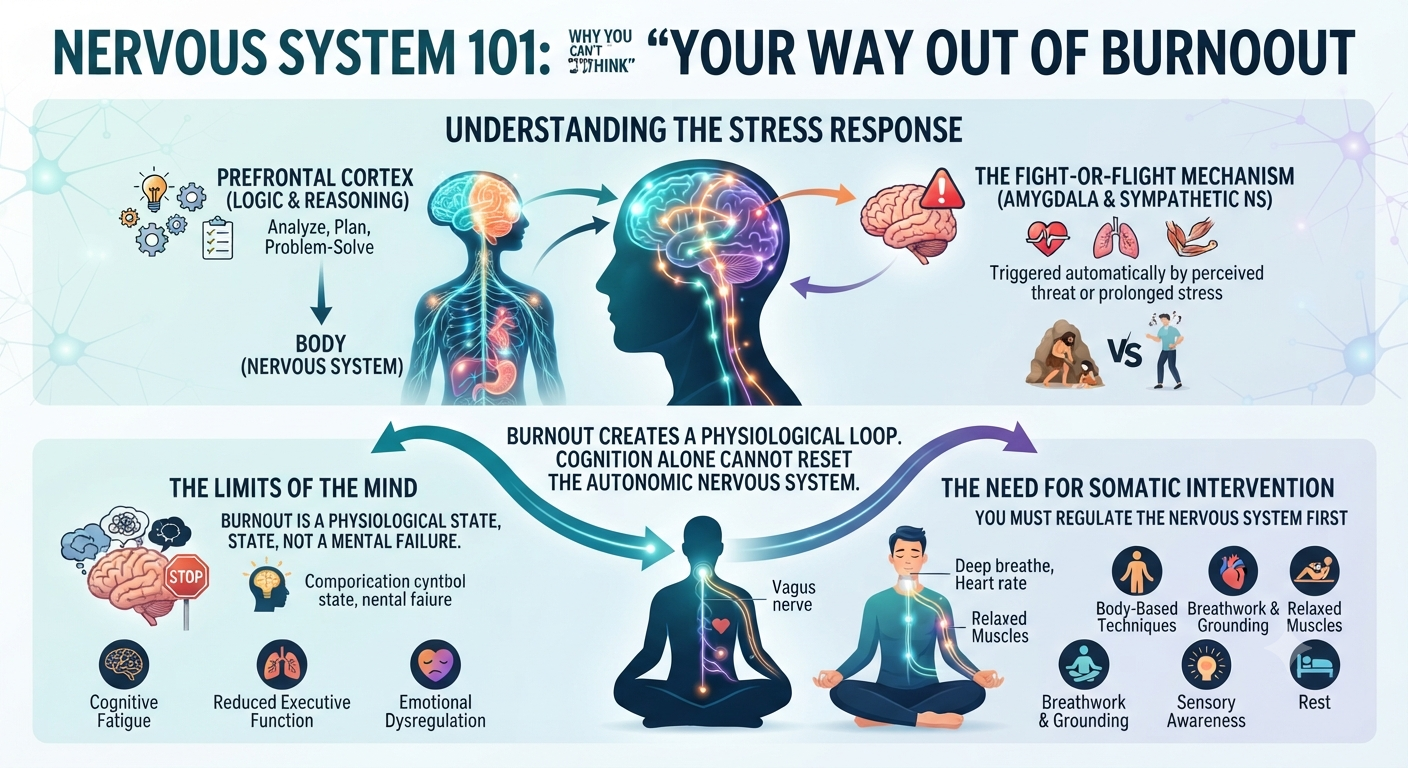
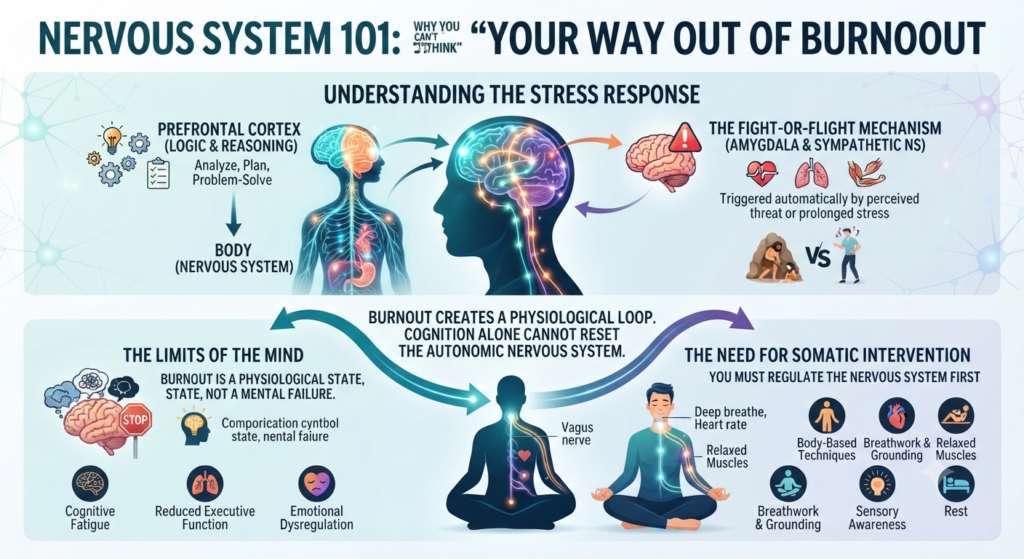
Here’s the part that matters most: none of that starts in your thoughts. It starts in your nervous system.
When you’re under sustained pressure, your body releases stress hormones designed for short bursts of demand — useful for a genuine emergency, harmful when switched on for weeks or months at a time. Long-term exposure to these stress chemicals, sometimes called “allostatic load,” has real, measurable effects on the brain and body, including changes to memory, mood regulation, and the very systems you’d need to feel calm and think clearly again (McEwen, 1998).
In other words: burnout physically changes how your brain is operating. You can’t out-think a nervous system that’s stuck in overdrive, for the same reason you can’t talk your way out of a fever.
Your nervous system has two main modes: one built for action and alertness (sympathetic), and one built for rest, digestion, and recovery (parasympathetic). Under chronic stress, your body gets stuck leaning toward the first one — even when there’s no actual emergency happening.
This is why willpower alone so often fails. You’re trying to use your thinking brain to override a survival system that isn’t designed to take instructions from logic. It responds to safety signals in the body, not to pep talks.
This is also why real recovery tends to start in the body, not the mind — through breath, rest, and nervous system regulation, rather than through trying harder to think differently.
Ayurveda mapped this territory long before modern neuroscience had the language for it.
Of the three doshas, Vata governs movement in the body — and this includes far more than digestion or circulation. Classical texts describe Vata as responsible for the carrying of impulses through the body, the initiation of speech, sensation, and even enthusiasm and a settled state of mind, alongside the more familiar functions like breath and circulation (Charaka Samhita, Sutrasthana 12). When Vata is balanced, the classical texts associate it with steadiness, vitality, and clarity. When it’s aggravated — through overwork, irregular routines, excess stimulation, or unresolved stress — the same texts describe restlessness, anxiety, disrupted sleep, and a scattered, ungrounded quality of mind.
That description will sound familiar to almost anyone who has lived through burnout. Ayurveda didn’t have a term for “sympathetic nervous system activation.” What it had was a precise, functional description of the same territory, built from careful, repeated observation.
This is where classical Ayurvedic practice and modern clinical research meet directly — not just conceptually, but in actual physiology.
Slow, controlled breathing measurably shifts the nervous system toward calm. A systematic review of the physiological effects of slow breathing found that it consistently increases markers of parasympathetic (“rest and recover”) activity via the vagus nerve, supporting emotional regulation and reduced physiological stress (Zaccaro et al., 2018).
This isn’t just a modern biohacking trend — it’s the same mechanism behind pranayama. A scientific review of yogic breathing techniques (pranayama) found that slow breathing practices reliably reduce sympathetic (“fight or flight”) activity and enhance parasympathetic tone, while fast breathing techniques did not produce the same calming effect (Nivethitha et al., 2016). This is a striking case of ancient practice and modern science converging on the same physiological pathway.
As with any area of ongoing research, individual responses vary, and breathwork is a support tool rather than a substitute for addressing the underlying causes of chronic stress. Still, the general direction of the evidence is well established and consistent across multiple studies.
You likely don’t need a diagnosis to recognise this pattern. Clients often describe it as:
None of these mean something is wrong with your character or your discipline. They mean your nervous system is asking for a different kind of support than “trying harder.”
This isn’t a case of Ayurveda predicting neuroscience, or neuroscience validating Ayurveda. It’s simpler: two very different systems, observing the same human body across very different timescales, both concluded that calm isn’t something you think your way into. It’s something you regulate your way into.
That’s the foundation this practice works from. Supporting Vata isn’t a separate wellness add-on from supporting the nervous system — Ayurveda described them as the same thing long before science had a name for either.
If you’ve been trying to think, push, or plan your way out of exhaustion — that’s not a failure of effort. It’s a sign your nervous system needs a different kind of support. Book a free discovery call and let’s look at what balance could actually look like for you.
Charaka Samhita. (n.d.). Sutrasthana, Chapter 12 (Vatakalakaliya Adhyaya) [Classical Ayurvedic text; original compilation estimated 100 BCE–200 CE. Translation edition to be confirmed by publisher.]
Maslach, C., & Leiter, M. P. (2016). Understanding the burnout experience: Recent research and its implications for psychiatry. World Psychiatry, 15(2), 103–111. https://doi.org/10.1002/wps.20311
McEwen, B. S. (1998). Protective and damaging effects of stress mediators. New England Journal of Medicine, 338(3), 171–179. https://doi.org/10.1056/NEJM199801153380307
Nivethitha, L., Mooventhan, A., & Manjunath, N. K. (2016). Effects of various prānāyāma on cardiovascular and autonomic variables. Ancient Science of Life, 36(2), 72–77. https://doi.org/10.4103/asl.ASL_178_16
Zaccaro, A., Piarulli, A., Laurino, M., Garbella, E., Menicucci, D., Neri, B., & Gemignani, A. (2018). How breath-control can change your life: A systematic review on psycho-physiological correlates of slow breathing. Frontiers in Human Neuroscience, 12, Article 353. https://doi.org/10.3389/fnhum.2018.00353