The Gut-Brain Connection Explained | Ayurveda & Modern Science
Feeling anxious makes your stomach hurt. A bad gut day ruins your mood. Here’s the science behind the gut-brain connection — and what Ayurveda has said about it for centuries.
Think about the last time you were really nervous before something big — a job interview, a first date, a difficult conversation. Where did you feel it first?
For most people, it’s not the head. It’s the stomach.
That queasy, tight, “butterflies” feeling isn’t just a figure of speech. It’s your gut and your brain talking to each other in real time — and it’s one of the most well-documented, and most underestimated, relationships in the entire body.
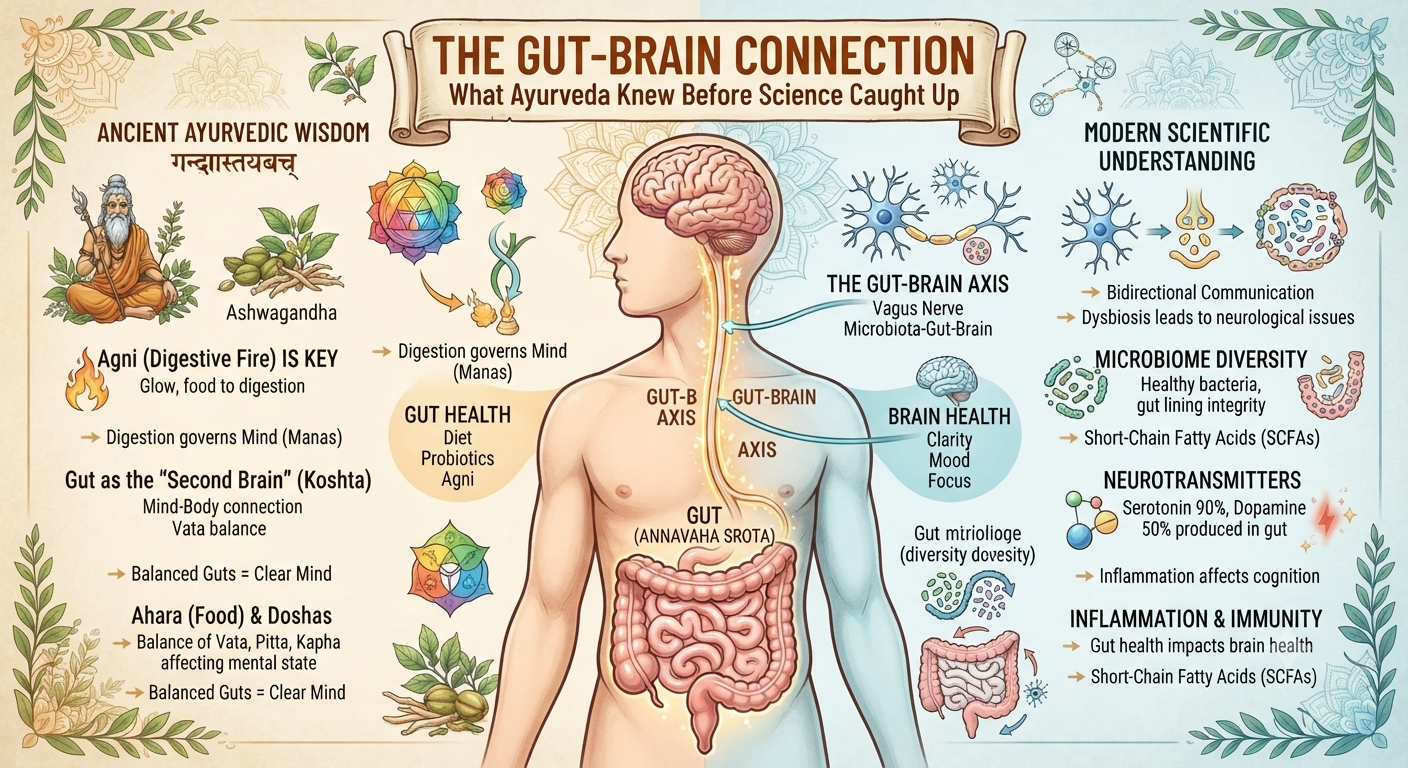
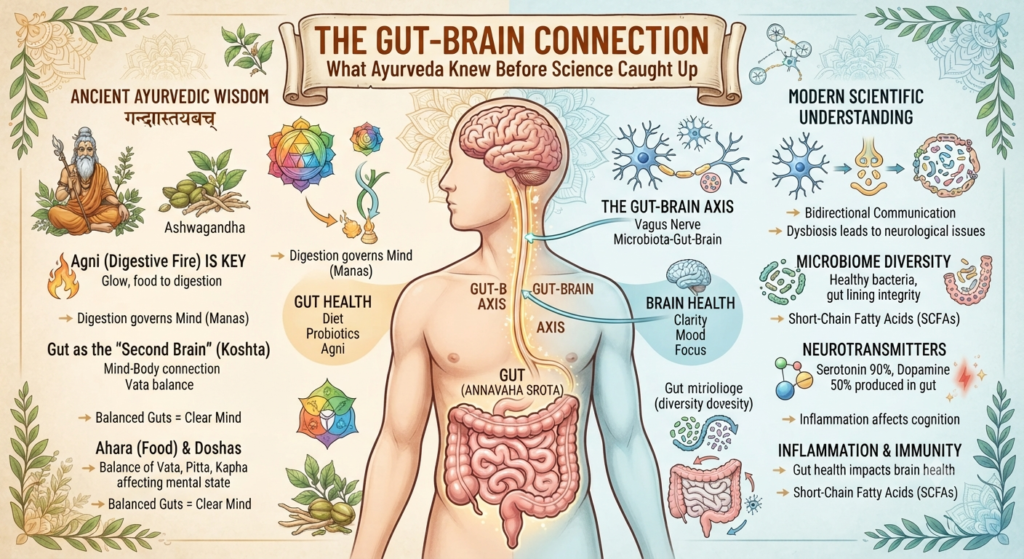
In plain terms: your gut and your brain are in constant two-way communication, mostly via a direct line called the vagus nerve, along with hormones, immune signals, and chemicals made by the trillions of bacteria living in your digestive tract.
This isn’t a loose metaphor. Roughly 90% of your body’s serotonin — the neurotransmitter most associated with mood and wellbeing — is made in your gut, not your brain (Yano et al., 2015). Your digestive system has its own dense network of neurons, sometimes called the “second brain,” which is why gut discomfort so often shows up as anxiety, brain fog, or low mood, and why stress so reliably shows up as bloating, cramping, or a “sick to my stomach” feeling.
Your gut isn’t just where digestion happens. It’s actively shaping how you feel.
Long before anyone had heard of the vagus nerve, Ayurveda built an entire framework around this exact idea.
Central to Ayurvedic medicine is the concept of Agni — your digestive fire. Ayurveda has always treated Agni as more than a mechanical process of breaking down food. In fact, the classical definition of a healthy person given in the Sushruta Samhita names balanced Agni and a clear, cheerful mind in the very same sentence — as parts of one unified state of health, not as separate conditions (Sushruta Samhita, Sutrasthana 15.41). Ayurveda also describes Agni as what transforms food into Ojas, a refined vital essence said to sustain strength, immunity, and mental steadiness.
This is a strikingly close match to what modern neuroscience now calls the gut-brain axis — just described in a different vocabulary, thousands of years earlier. Ayurveda didn’t have microscopes or neurotransmitter panels. What it had was careful, repeated observation: that how someone digests seems to shape how someone feels, and that the two could never really be treated separately.
This is where the ancient framework and modern research genuinely converge.
Your gut produces the chemicals that shape your mood. As mentioned above, the majority of the body’s serotonin is produced in the gut by specialised cells, and researchers have shown that specific gut bacteria directly influence how much serotonin gets made (Yano et al., 2015). Your gut isn’t a passive digestion tube — it’s an active chemical factory that talks directly to your brain chemistry.
This relationship goes both directions, constantly. A comprehensive scientific review of the gut-brain axis describes the gut and brain as being in continuous communication through the nervous system, immune system, and hormonal pathways, with this relationship playing a role in mood, stress response, and even long-term brain health (Cryan et al., 2019). This is precisely the “always connected, never separate” relationship Ayurveda described through Agni.
Changing gut bacteria can measurably change how people feel. In a clinical trial, healthy adults who took a specific daily probiotic for a month showed real reductions in psychological distress, anger, and anxiety, along with lower levels of the stress hormone cortisol, compared to those who didn’t (Messaoudi et al., 2011). This is one of the clearest human demonstrations that what’s happening in your gut doesn’t stay in your gut — it reaches your emotional state.
As with any evolving field, gut-brain research is still developing — the exact mechanisms are complex, findings vary between individuals, and researchers are cautious about overstating how much any single dietary change will affect mood in a given person. The general relationship, though, is well established and taken seriously by mainstream neuroscience and gastroenterology alike.
You don’t need a lab test to notice the gut-brain connection in your own life. Clients often recognise it in patterns like:
None of these are “just in your head” — and they’re not “just in your gut” either. They’re the same system, responding as one.
This isn’t a case of Ayurveda being proven right by science, or science rediscovering something it should be given full credit for. It’s simpler than that: two very different traditions, using two very different methods, kept arriving at the same observation — that digestion and emotional wellbeing are inseparable.
That’s precisely the intersection this practice works from. Supporting Agni isn’t just about digestion in isolation, and supporting the nervous system isn’t just about stress in isolation. They were never separate problems to begin with.
If your mood, energy, or focus has felt tangled up with your digestion — you’re not imagining it, and you don’t have to untangle it alone. Book a free discovery call and let’s look at what your gut has actually been trying to tell you.
Sushruta Samhita. (n.d.). Sutrasthana, Chapter 15, Verse 41 [Classical Ayurvedic text; original compilation estimated 6th century BCE–4th century CE. Translation edition to be confirmed by publisher.]
Cryan, J. F., O’Riordan, K. J., Cowan, C. S. M., Sandhu, K. V., Bastiaanssen, T. F. S., Boehme, M., Codagnone, M. G., Cussotto, S., Fulling, C., Golubeva, A. V., Guzzetta, K. E., Jaggar, M., Long-Smith, C. M., Lyte, J. M., Martin, J. A., Molinero-Perez, A., Moloney, G., Morelli, E., Morillas, E., … Dinan, T. G. (2019). The microbiota-gut-brain axis. Physiological Reviews, 99(4), 1877–2013. https://doi.org/10.1152/physrev.00018.2018
Mayer, E. A. (2011). Gut feelings: The emerging biology of gut-brain communication. Nature Reviews Neuroscience, 12(8), 453–466. https://doi.org/10.1038/nrn3071
Messaoudi, M., Violle, N., Bisson, J.-F., Desor, D., Javelot, H., & Rougeot, C. (2011). Beneficial psychological effects of a probiotic formulation (Lactobacillus helveticus R0052 and Bifidobacterium longum R0175) in healthy human volunteers. Gut Microbes, 2(4), 256–261. https://doi.org/10.4161/gmic.2.4.16108
Yano, J. M., Yu, K., Donaldson, G. P., Shastri, G. G., Ann, P., Ma, L., Nagler, C. R., Ismagilov, R. F., Mazmanian, S. K., & Hsiao, E. Y. (2015). Indigenous bacteria from the gut microbiota regulate host serotonin biosynthesis. Cell, 161(2), 264–276. https://doi.org/10.1016/j.cell.2015.02.047