Bio-Individuality Explained: The Ancient Science of Satmya
Bio-individuality is trending in wellness circles, but Ayurveda named this idea “Satmya” millennia ago. Explore the evidence behind personalized health.
If you’ve spent any time on wellness social media lately, you’ve probably seen the term “bio-individuality” everywhere. Influencers are sharing personalised supplement stacks. Podcasts are debating genetic testing for diet plans. Continuous glucose monitors have gone from medical devices to lifestyle accessories. The core message is always the same: generic health advice doesn’t work, because your body isn’t generic.
It’s a compelling idea, and it’s having a real cultural moment. But here’s what most of the conversation misses: this isn’t a new discovery. It’s a very old one, wearing new language.
Ayurveda has a word for it. That word is Satmya.
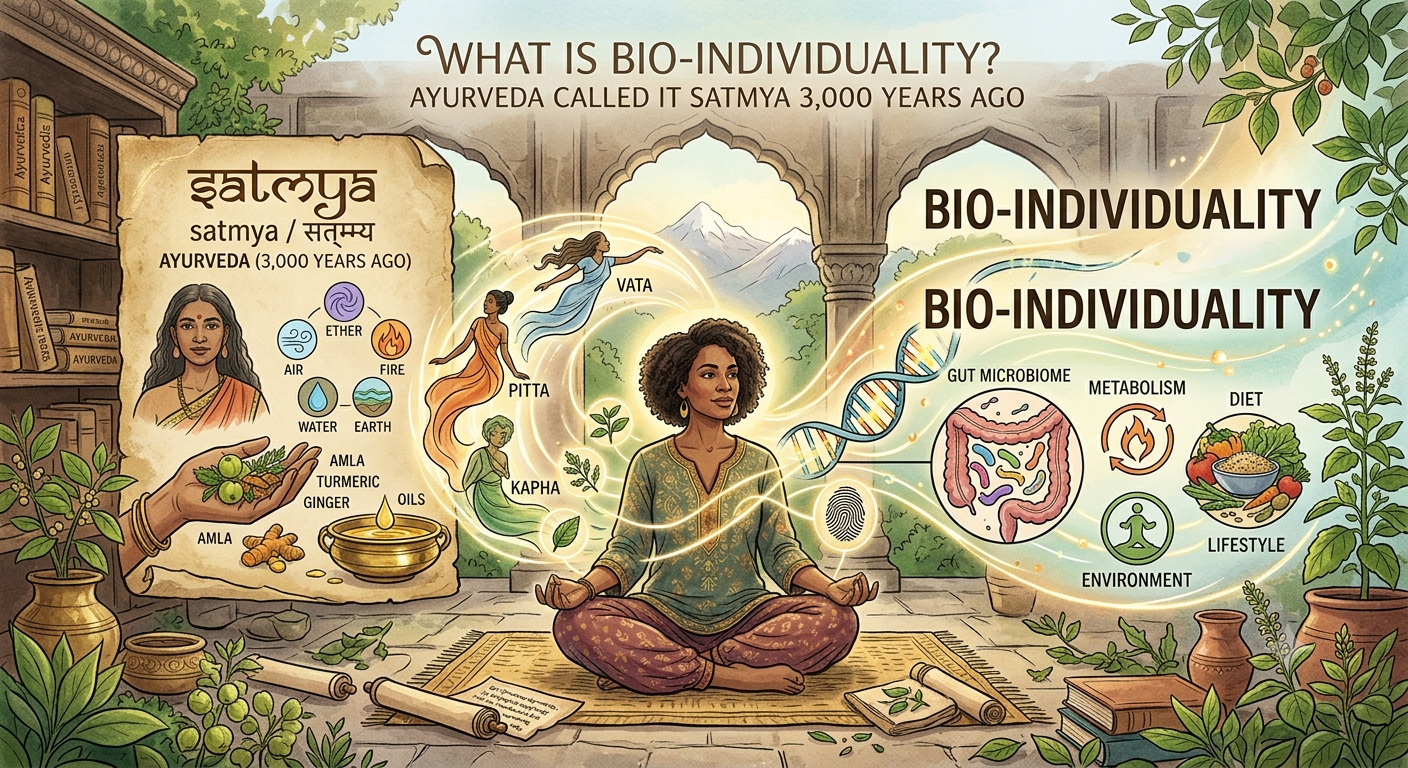
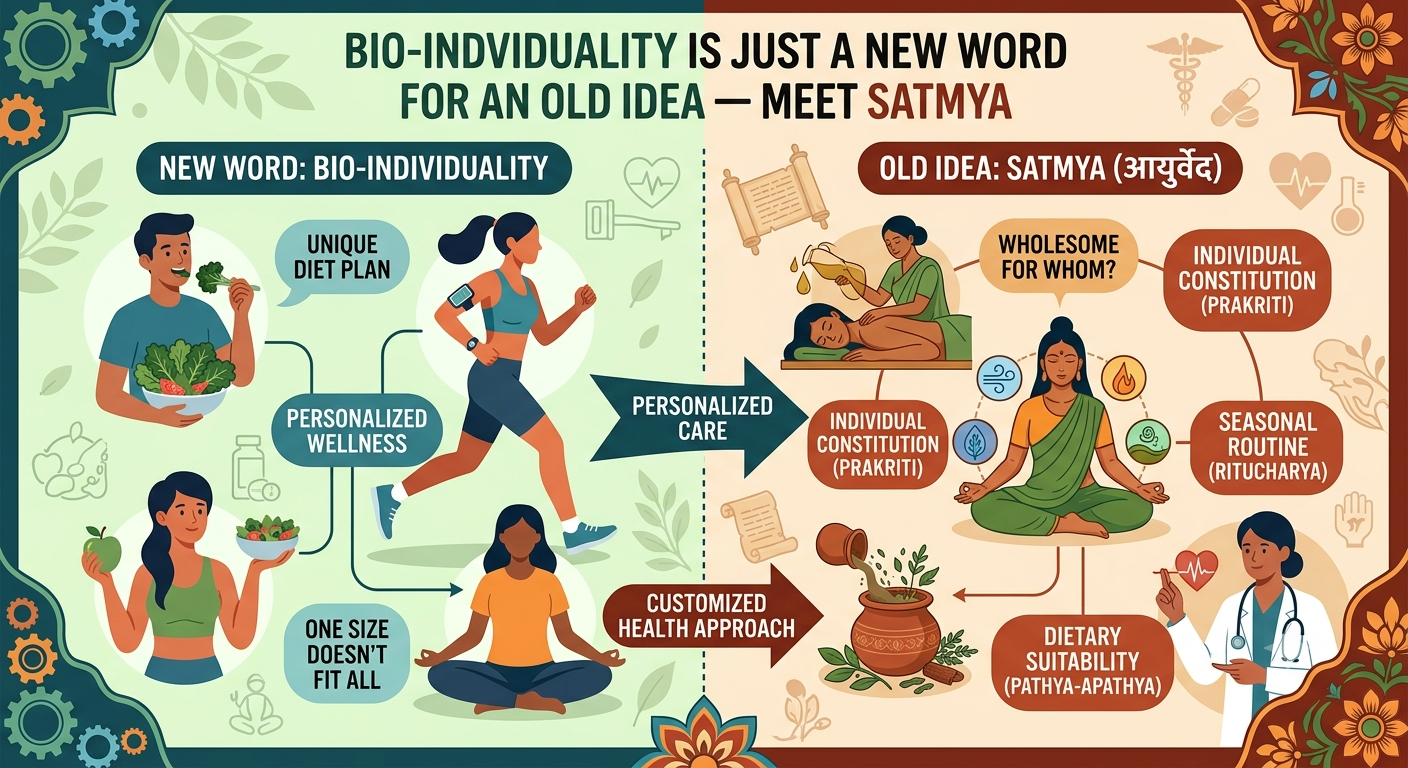
In modern wellness usage, bio-individuality refers to the idea that each person has a unique biological and lifestyle profile — genetics, microbiome composition, stress levels, environment, history — and that health strategies should be built around that profile rather than applied uniformly to everyone.
It’s a reasonable, evidence-supported idea. It’s also, in many corners of the internet, being treated as something brand new: a discovery made possible by wearables, AI, and genetic testing.
That framing leaves out three thousand years of precedent.
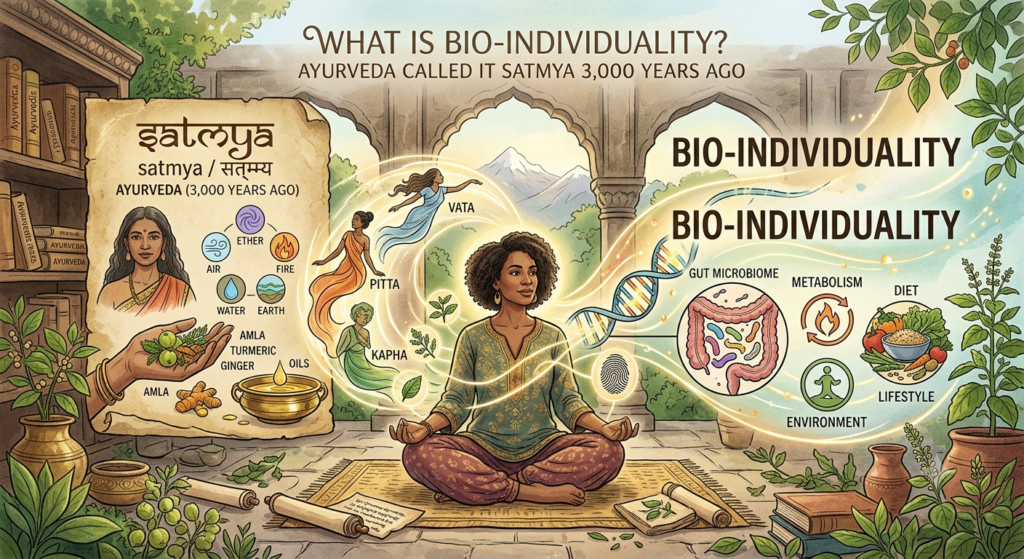
In classical Ayurvedic thought, Satmya refers to what is genuinely suitable for a specific person — not what’s universally correct, but what actually agrees with an individual’s constitution (Prakriti), digestive capacity (Agni), current life stage, and environment.
Ayurveda takes this further than most modern personalization models. It doesn’t just say “your biology is unique.” It provides a structured framework — the tridosha model of Vata, Pitta, and Kapha — for actually mapping that uniqueness, and for tracking how it shifts with age, season, and circumstance. Satmya isn’t a fixed diagnosis. It’s a continuously updated answer to the question: what does this body need, right now?
This is the same underlying logic that today’s precision health movement is reaching toward — just built on a different evidence base, and developed a very long time before glucose monitors existed.
Modern research is, in several respects, independently arriving at conclusions Ayurveda proposed millennia ago.
People genuinely respond differently to identical food. In a landmark study of 800 participants, researchers found substantial variability in blood sugar response to the same meals — variability so significant that a model incorporating individual factors like the gut microbiome outperformed standard advice based on calorie or carbohydrate counts alone (Zeevi et al., 2015). In other words: two people can eat the same meal and have meaningfully different physiological responses. Uniform dietary advice was never going to fit everyone equally.
Ayurvedic constitutional types have measurable biological correlates. Researchers analysing genome-wide gene expression in individuals classified by Ayurvedic Prakriti (Vata, Pitta, Kapha) found significant differences in biochemical, hematological, and gene expression profiles between constitution types — including enrichment in genes linked to immune response, blood coagulation, and metabolic regulation (Prasher et al., 2008). A related genome-wide analysis found further molecular correlates distinguishing these constitutional groups, including differences connected to oxygen-sensing pathways relevant to disease predisposition (Govindaraj et al., 2015). Put simply: an ancient system of classifying individual constitution appears to track with real, measurable biological differences.
The scientific community now formally recognises personalization as the frontier of nutrition science. A major review in the BMJ concluded that nutrition interventions tailored to individual genetics, gut microbiota, and health status hold real promise, and specifically noted that generic, one-size-fits-all approaches dilute results by ignoring individual variation (Ordovas et al., 2018).
As with any emerging field, this research is ongoing and not universally agreed upon — some of the methods used to demonstrate inter-individual variability have themselves been debated in the scientific literature, and single-population studies typically require independent replication before conclusions are considered settled.
None of this proves Ayurveda “got everything right.” Ayurvedic theory and modern biomedical science are different systems, built on different methods, and they shouldn’t be flattened into each other. But the directional agreement is hard to ignore: three thousand years apart, both traditions landed on the same conclusion — that individual variation matters more than universal rules.
Trends fade. That’s what makes them trends. “Bio-individuality” as a hashtag will eventually be replaced by the next wellness buzzword.
Satmya won’t, because it was never a trend to begin with. It’s the foundation BioSatmya was built on — long before “bio-individuality” started trending in the algorithm. The current cultural moment isn’t the reason we work this way. It’s simply the first time the mainstream conversation has caught up to a framework that’s been tested, refined, and practiced for millennia.
That distinction matters. It means the approach isn’t going anywhere once the trend cycle moves on — because it was never dependent on the trend cycle to begin with.
The practical question isn’t whether personalization matters — the science and the tradition now agree that it does. The real question is how you actually find what’s suitable for your body, at this point in your life.
That’s not something a quiz or a generic meal plan can answer. It takes a structured understanding of your constitution, combined with real attention to how your body responds over time — which is precisely the intersection of Ayurvedic assessment and psychological insight this practice is built around.
If you’re ready to find out what’s actually suitable for you — not for your friend, not for an influencer, but for your own biology — book a free discovery call and let’s start mapping your Satmya.
Govindaraj, P., Nizamuddin, S., Sharath, A., Jyothi, V., Rotti, H., Raval, R., Nayak, J., Bhat, B. K., Prasanna, B. V., Shintre, P., Sule, M., Joshi, K., Ghodke, S., Bharadwaj, R., Gangadharan, G. G., Nair, S., Gopinath, P. M., Patwardhan, B., & Thangaraj, K. (2015). Genome-wide analysis correlates Ayurveda Prakriti. Scientific Reports, 5, 15786. https://doi.org/10.1038/srep15786
Ordovas, J. M., Ferguson, L. R., Tai, E. S., & Mathers, J. C. (2018). Personalised nutrition and health. BMJ, 361, k2173. https://doi.org/10.1136/bmj.k2173
Prasher, B., Negi, S., Aggarwal, S., Mandal, A. K., Sethi, T. P., Deshmukh, S. R., Purohit, S. G., Sengupta, S., Khanna, S., Mohammad, F., Garg, G., Brahmachari, S. K., Sengupta, S., Mukerji, M., & Indian Genome Variation Consortium. (2008). Whole genome expression and biochemical correlates of extreme constitutional types defined in Ayurveda. Journal of Translational Medicine, 6, 48. https://doi.org/10.1186/1479-5876-6-48
Zeevi, D., Korem, T., Zmora, N., Israeli, D., Rothschild, D., Weinberger, A., Ben-Yacov, O., Lador, D., Avnit-Sagi, T., Lotan-Pompan, M., Suez, J., Mahdi, J. A., Matot, E., Malka, G., Kosower, N., Rein, M., Zilberman-Schapira, G., Dohnalová, L., Pevsner-Fischer, M., … Segal, E. (2015). Personalized nutrition by prediction of glycemic responses. Cell, 163(5), 1079–1094. https://doi.org/10.1016/j.cell.2015.11.001